
Welcome to the Impaired Driving section of the CCSA Web Archive Library.
Please browse the publications below, which are organized by their year of publishing. Publications in the Web Archive Library were published at least five years ago. Insights from these documents may no longer be current and are to be used for comparison and historical reference purposes only.
Please be aware, for many of our older publications, CCSA cannot guarantee compliance with Accessibility for Ontarians with Disabilities Act (AODA) standards.
If you would like to continue and access the document as is, please enter your email address in field that will appear when you click on the “request PDF” link. You will immediately receive an email with a link to the document.
If you would like to receive an accessible version of the document, please email AODA-requests@ccsa.ca and we will provide it as soon as possible.
Thank you.
Publications from 2020
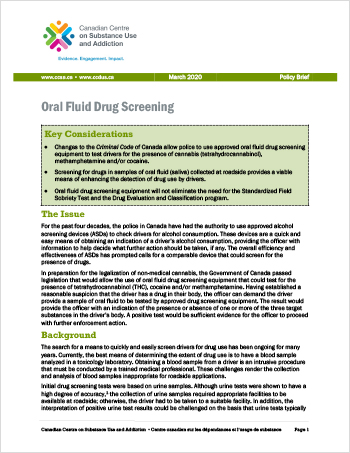
Oral Fluid Drug Screening [Policy Brief]
Oral fluid drug screening equipment was approved for legal use by law enforcement in 2018 to detect the presence of certain drugs, including cannabis, in drivers. Officially...
Who Drives After Using Drugs? A Review of Prominent Characteristics
Explores the prominent characteristics of people who drive after using drugs and the...
Developing National Indicators for Drug-impaired Driving in Canada: Practices in Detection, Monitoring and Reduction
Canada lacks a standardized set of national indicators to adequately measure the full impact of...
Publications from 2019
![Key Issues in Drug-impaired Driving [Policy Brief]](/sites/default/files/2019-10/CCSA-Key-Issues-Drug-impaired-Driving-Policy-Brief-2019-en.jpg)
Key Issues in Drug-impaired Driving [Policy Brief]
This policy brief presents the key issues for minimizing the harms associated with cannabis-impaired driving. It provides policy makers with information to assist in developing...
![Drug Per Se Laws [Policy Brief]](/sites/default/files/2019-09/CCSA-Drug-per-Se-Laws-Policy-Brief-09-2019-en_0.jpg)
Drug Per Se Laws [Policy Brief]
Examines the effectiveness of implementing drug “per se” laws, whereby it is an offence to drive with a blood concentration of alcohol or drugs in excess of a specified...
Publications from 2017
![Impaired is Impaired: No Matter What Your Ride [summer poster]](/sites/default/files/2019-05/CCSA-Drug-Impaired-Driving-Toolkit-Ride-Summer-Poster-2017-en.jpg)
Impaired is Impaired: No Matter What Your Ride [summer poster]
Uses images to illustrate that impaired driving is dangerous regardless of the vehicle you...
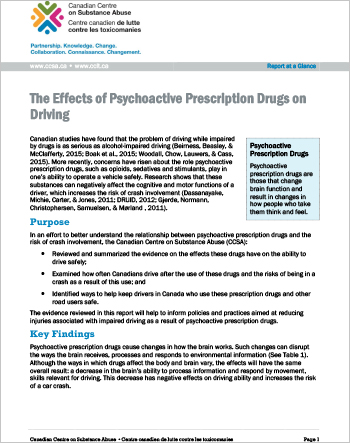
The Effects of Psychoactive Prescription Drugs on Driving (Report at a Glance)
Summarizes a technical report of the same name on the adverse effects of psychoactive...
The Effects of Psychoactive Prescription Drugs on Driving (Report)
Examines how psychoactive prescription drugs, such as cocaine, cannabis and methamphetamine, can...
![Drug-Impaired Driving: Know the Effects [infographic]](/sites/default/files/2019-04/CCSA-Drug-Impaired-Driving-Toolkit-Infographic-2018-en.jpg)
Drug-Impaired Driving: Know the Effects [infographic]
Illustrates that drugs, including marijuana, opioids, sedatives and stimulants, can negatively affect driving ability and increase the risk of crashes.
![Impaired is Impaired: No Matter What Your Ride [winter poster]](/sites/default/files/2019-04/CCSA-Drug-Impaired-Driving-Toolkit-Ride-Winter-Poster-2017-en.jpg)
Impaired is Impaired: No Matter What Your Ride [winter poster]
Uses images to illustrate that impaired driving is dangerous regardless of the vehicle you...
Key Messages about Drug-Impaired Driving in Rural and Remote Areas
Publications from 2016
Key Messages about Drug-Impaired Driving
Drug-Impaired Driving Backgrounder
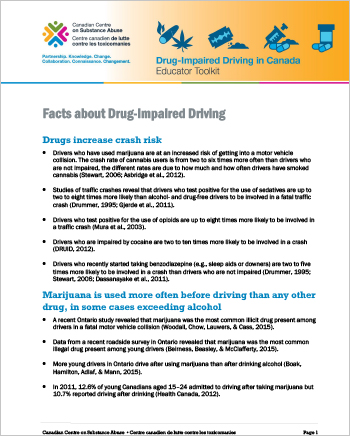
Facts about Drug-Impaired Driving
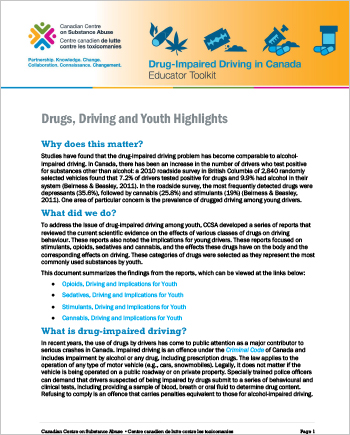
Drugs, Driving and Youth Highlights
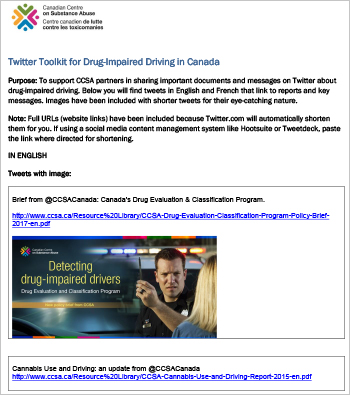
Twitter Toolkit for Drug-Impaired Driving in Canada
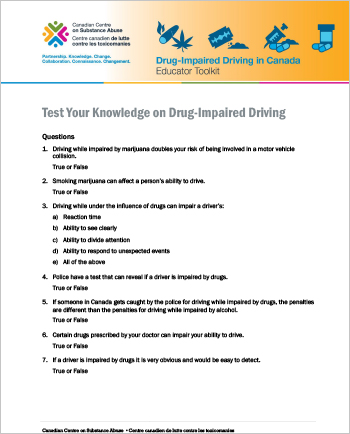
Test Your Knowledge on Drug-Impaired Driving
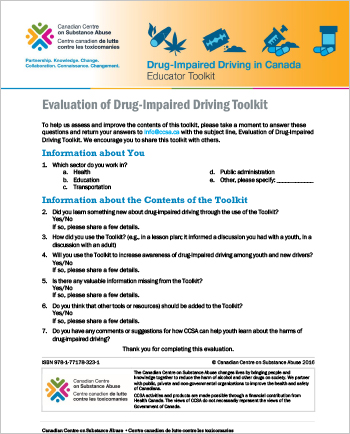
Evaluation of Drug-Impaired Driving Toolkit
![Effects of Drugs on the Body and Driving [handout]](/sites/default/files/2019-04/CCSA-Drug-Impaired-Driving-Toolkit-Handout-2016-en.jpg)
Effects of Drugs on the Body and Driving [handout]
Highlights the ways that cannabis, stimulants, opioids and sedatives affect the body and brain, and how they impact a person’s ability to drive. The poster warns of the risks...
Publications from 2010 to 2014
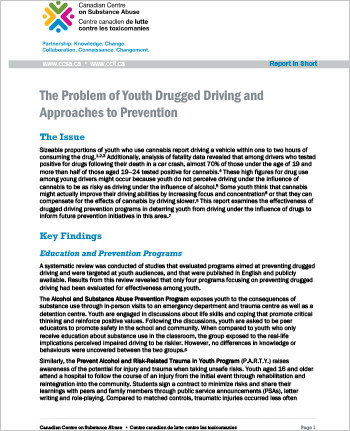
The Problem of Youth Drugged Driving and Approaches to Prevention: Report in short
The Characteristics of Youth Passengers of Impaired Drivers: Technical Report
Reviews and summarizes the research on the characteristics of youth who ride with impaired...
The Problem of Youth Drugged Driving and Approaches to Prevention: A Systematic Literature Review
Reviews the literature on approaches aimed at reducing drugged driving among youth. The evidence...
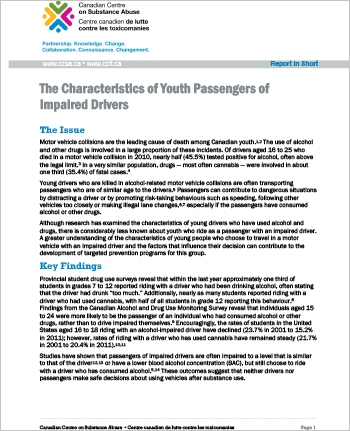
The Characteristics of Youth Passengers of Impaired Drivers (Report in Short)
Summarizes a technical report of the same name that analyzes the characteristics of youth who...
Alcohol and Drug Use Among Drivers: British Columbia Roadside Survey 2010
This publication has been archived on the CCSA website and was current when it was published. It...
A Comparison of Drug- and Alcohol-involved Motor Vehicle Driver Fatalities
This publication has been archived on the CCSA website and was current when it was published. It...
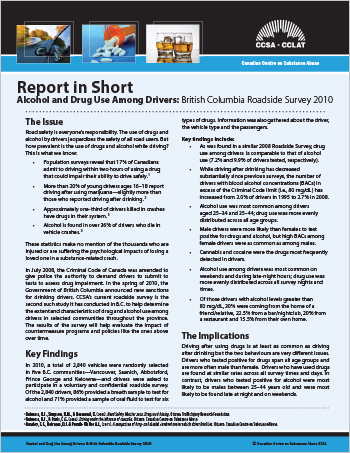
Alcohol and Drug Use Among Drivers: British Columbia Roadside Survey 2010 (Report in Short)
This publication has been archived on the CCSA website and was current when it was published. It...
Publications before 2010
Alcohol and Drug Use Among Drivers: British Columbia Roadside Survey 2008
This publication has been archived on the CCSA website and was current when it was published. It...
Report in Short – Drugs and Driving
This publication has been archived on the CCSA website and was current when it was published. It is available for reference or research purposes.
Driving after Drinking in Canada: Analysis Drawn from the 2004 Canadian Addiction Survey
This publication has been archived on the CCSA website and was current when it was published. It...
Driving Under the Influence of Cannabis : Analysis drawn from the 2004 Canadian Addiction Survey
This publication has been archived on the CCSA website and was current when it was published. It...
Heading
Explore CCSA’s Guidance, Tools and Resources
All our research-based publications, tools and resources are divided into six different categories of interest. They support evidence-based decision-making on substance use health issues. Select your area of interest from the choices below:
Heading
Substances
Delve into key resources on commonly used substances, such as alcohol, cannabis, opioids, stimulants and psychedelics.
Heading
Personal and Societal Impacts
Get insights on the personal and societal impacts of substance use and addiction , including gambling and impaired driving, and their effects on health, safety, and social well-being.
Heading
Communities
Communities share common interests, values or goals, and interact with one another to build relationships and help networks. These materials support more inclusive, equitable, and community-informed responses to substance use and addiction.
Heading
Treatment and Prevention
Explore medical, psychological, and social approaches aimed at helping individuals avoid or recover from substance use disorders.
Heading
Youth
Learn about factors influencing substance use in young people, including childhood trauma and brain development, and get tools to support adult allies in leading meaningful, evidence-informed conversations with youth.
Heading
Substance Use and the Workplace
Substance use has a significant impact on the workplace, potentially affecting safety, productivity and employee well-being. Explore research on substance use in various industries.