Project Overview
Urinalysis and self-reporting allow us to monitor drugs on the illegal market for the substances they contain and compare this to what people who use those drugs expect them to contain. The process involves analyzing urine samples for metabolites of substances after people consume them and compare these with information from a survey that asks what people intended to consume. Compared to drug checking, this process avoids storing and transporting illegal substances for testing and does not require that participants sacrifice drug samples for testing.
CUSP Reports
New research shows that the contents of drugs from the unregulated supply remain unpredictable. In fact, there’s often a difference between what drugs people think they are taking and what they are actually consuming. This increases the risk of harm for people who use drugs.
To better understand substance use trends and how expected substance use contents compares with actual substance use contents across Canada, data was collected from 2,634 participants at harm reduction sites in seven regions between January 2021 and April 2023. The reporting sites are in British Columbia, Edmonton, Regina, Ottawa, Peel, Quebec and Nova Scotia. The data has been compiled into Community Urinalysis and Self-Report Project (CUSP) Cross-Canada Report 2021–2023 series. You can find the reports linked below.
Past Reports
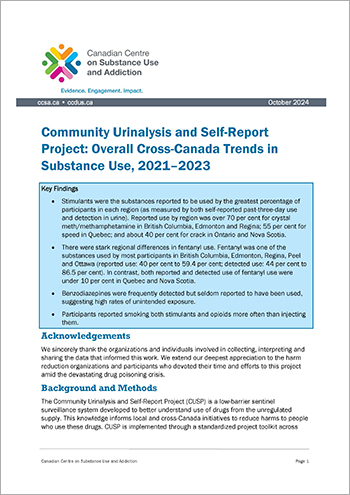
Community Urinalysis and Self-Report Project: Overall Cross-Canada Trends in Substance Use, 2021–2023
Presents substance use trends and describes whether expected substance use aligned with actual...
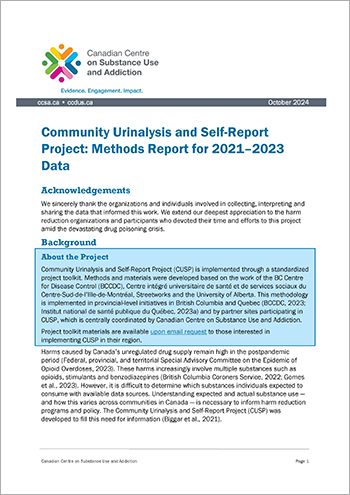
Community Urinalysis and Self-Report Project: Methods Report for 2021–2023 Data
Intended to accompany the Community Urinalysis and Self-Report Project: Cross-Canada Report on...
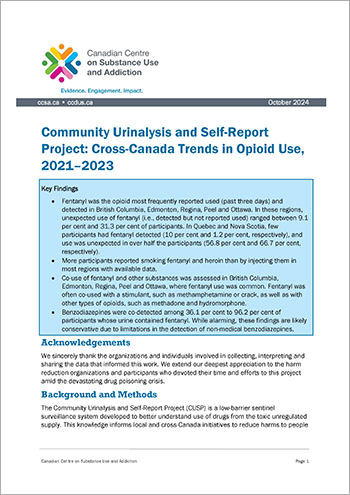
Community Urinalysis and Self-Report Project: Cross-Canada Trends in Opioid Use 2021–2023
Presents opioid and fentanyl use trends and describes whether expected substance use aligned...
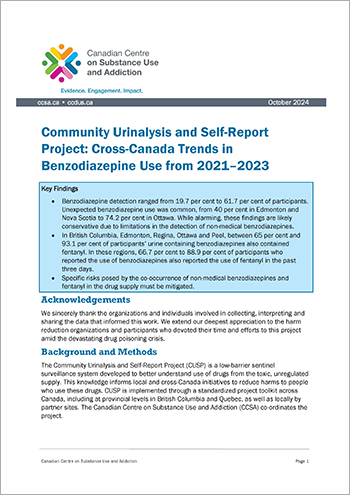
Community Urinalysis and Self-Report Project: Trends in Benzodiazepine Use 2021–2023
Presents benzodiazepine use trends and describes whether expected substance use aligned with...
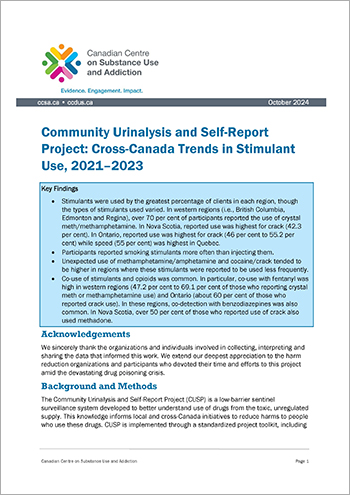
Community Urinalysis and Self-Report Project: Cross-Canada Trends in Stimulant Use 2021–2023
Presents stimulant use trends and describes whether expected substance use aligned with actual...
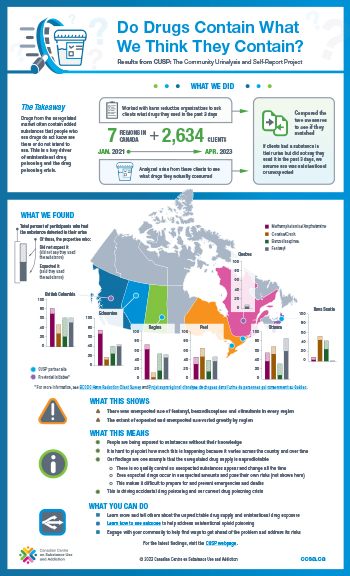
Do Drugs Contain What We Think They Contain? Results from CUSP: The Community Urinalysis and Self-Report Project
Visually presents substance use trends and describes whether expected substance use aligned with...
Project History
The standardized system used by the Community Urinalysis and Self-Report Project (CUSP) for monitoring the content of illegal drugs was originally developed by the B.C. Centre for Disease Control (BCCDC) and the Centre intégré universitaire de santé et de services sociaux du Centre-Sud-de-l’Ile-de-Montréal (CCSMTL). It was developed with feedback from individuals who use drugs. CCSA is now collaborating with BCDCC and CCSMTL to expand this system to a national scale through a grant from Health Canada’s Substance Use and Addictions Program titled, “Developing National Surveillance of Illicit Drug Content.”
The system uses urine screening to determine the contents of drugs taken. This method avoids storing and transporting illegal substances; does not require that participants sacrifice drug samples for testing; avoids exposing testers to violence associated with the drug trade; and is more reflective of the street-level products available than testing of products seized by police.
The system also includes a survey that participants complete when they submit their urine for testing, indicating what drugs they think they took. The combination of survey data with the urine screening results shows any substances that participants took unintentionally or unknowingly, and any substances they think they took that were in fact not present. The survey can be adapted to include questions about emerging local or national issues to capture the changing preferences and needs of people who use drugs.
The project will lead to local reporting and national comparisons and publications outlining the findings of drug-use trends and emerging issues. The long-term goal for the project is that people who use drugs can receive better harm reduction and health services based on the data the project collects.
Project Timeline
CUSP was developed and rolled out in multiple phases:
Heading
Phase 1 (2018-2019)
- Development of a pilot system for combining a survey with urine drug testing at three sites
- Sites: British Columbia, Montreal and Edmonton
Heading
Phase 2 (2019-2021)
- Development of a standardized project toolkit and expansion to additional sites
- Sites: Manitoba, Laval, Newfoundland and Labrador, Nova Scotia and Thunder Bay
Heading
Phase 3 (2021-2023)
- Continued expansion across Canada and development of additional toolkit materials (e.g., support for qualitative data collection)
Partners and Collaborators
CCSA would like to acknowledge and thank the following partners for developing CUSP.
| Site Location | Organization | Local Study Leads |
|---|---|---|
| Alberta (Edmonton) | University of Alberta StreetWorks, Edmonton | Elaine Hyshka Marliss Taylor and Richard Herrick |
| British Columbia | B.C. Centre for Disease Control, Vancouver In-kind support from: Regional Harm Reduction Coordinators, B.C. Ministry of Health and Vancouver Area Network of Drug Users | Jane Buxton, Brittany Graham, Kristi Papamihali |
| Quebec (Montreal) | Centre intégré universitaire de santé et de services sociaux du Centre-Sud-de-l’Ile-de-Montréal, Quebec Toxicology Centre | Pascale Leclerc, Carole Morissette Nicolas Caron |
CCSA would like to acknowledge and thank the following partners for implementing CUSP.
Site Location | Organization | Local Study Leads |
|---|---|---|
| Manitoba | Manitoba Harm Reduction Network Winnipeg Regional Health Authority | Veda Koncan Paula Migliardi |
| Newfoundland and Labrador | Eastern Health AIDS Committee of Newfoundland and Labrador | Jane Henderson Emily Wadden, Alexe Morgan |
| Nova Scotia | Nova Scotia Health Authority Direction 180 | Patryk Simon Cindy McIsaac |
| Ontario (Thunder Bay) | Lakehead University NorWest Community Health Centres | Abigale Sprakes Juanita Lawson |
| Quebec (Laval) | Centre intégré de santé et de services sociaux de Laval | Catherine Boucher-Rodriguez |
Learn More
Although CUSP has ended, its findings and resources continue to inform substance use monitoring and service delivery efforts. If you would like to learn more about CUSP, please contact us at pkent@ccsa.ca